

Quick Answer: SSN exposure monitoring checks breach and dark web records for a customer’s Social Security number. It alerts the customer when that number appears. A partner who offers it under their own brand keeps the alert, the trust, and the recurring revenue.
- Permanent risk: An SSN cannot be reset, so exposure creates demand that never expires.
- Two signals: Exposure monitoring shows a number is circulating; credit monitoring shows it is being used.
- Branded alerts: The brand that sends the SSN alert keeps the trust, the renewal, and the cross-sell.
- Hash with care: Send only a SHA-1 digest, and treat that digest as carefully as the SSN itself.
- Clear next steps: Every alert should point to a credit freeze, an IRS IP PIN, and new-account checks.
Social Security numbers now sit at the center of most data breaches. In 2025, SSNs appeared in two-thirds of US breach reports, according to the Identity Theft Resource Center. A leaked password can be reset in a minute. A leaked SSN stays exposed for life.
That permanence changes the math for any company that holds customer trust. Javelin Strategy & Research found that new-account fraud victims rose 31% in 2025, reaching 5.4 million people. New-account fraud runs on stolen identity data, and the SSN is the core piece. So every customer with a leaked number carries a fraud risk that never fully expires.
SSN exposure monitoring answers that risk with a simple promise: we will tell you when your number shows up. The real question for partners is whose name sits on that alert. This guide covers what the service does, how it works, and why partners should own it.
Why SSN Exposure Monitoring Is a Permanent Need
A breach notice usually arrives long after the theft. By then, the SSN has already moved through criminal markets. Most other leaked data loses value over time. Passwords get changed, and cards get reissued. An SSN keeps its value because the person cannot replace it.
Synthetic identity fraud shows where this leads. Help Net Security covered a national credit bureau’s October 2026 fraud report. It put US lender exposure to synthetic identities at $2.4 billion in mid-2026. Criminals mix a real SSN with invented details to build a person who passes verification. Breach data supplies the real part.
For a partner, this permanence means the need never ends. A customer does not outgrow SSN exposure monitoring after one clean scan. New breaches keep adding fresh copies of old numbers to new markets. That is the profile of a subscription feature, not a one-time check.
Consider an illustrative partner with 200,000 active customers. Suppose 3% add a monitoring tier at a partner-set price of $4 per month. That tier would bring in $288,000 a year from one feature. These are round illustrative numbers, not benchmarks.
What SSN Exposure Monitoring Covers and What It Does Not
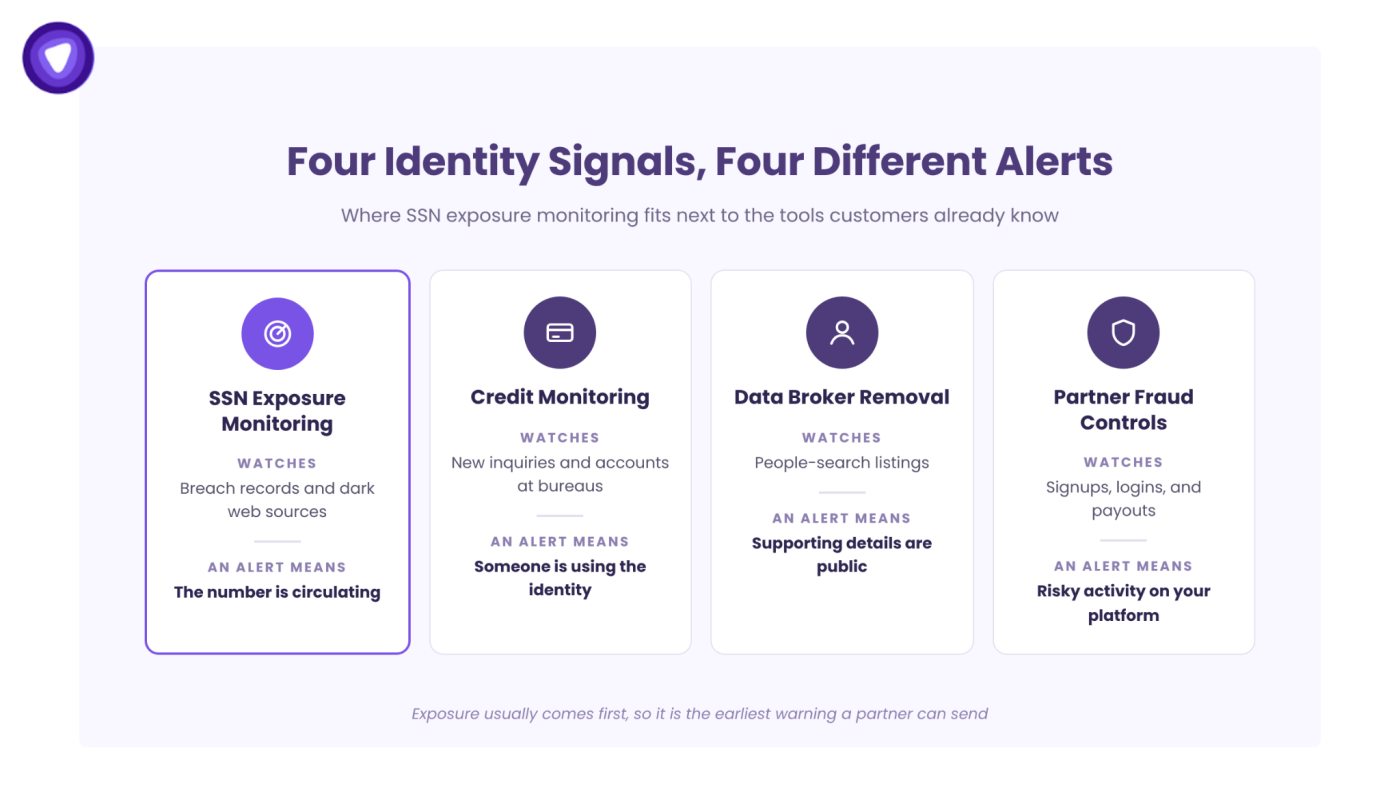
Buyers often treat every identity product as the same thing. In practice, each tool watches a different signal. An alert also means something different in each case.
Exposure Signals vs Usage Signals
SSN exposure monitoring watches breach records and dark web sources for a matching number. An alert means the number is circulating. It does not prove that anyone has used it yet.
Credit monitoring watches bureau files for new inquiries and new accounts. An alert there means someone has started to use the identity. The two signals work best together, because exposure usually comes first.
| Service | What It Watches | What an Alert Means | Best Next Step |
| SSN exposure monitoring | Breach records and dark web sources | The number is circulating | Freeze credit and lock tax filing |
| Credit monitoring | New inquiries and accounts at bureaus | Someone is using the identity | Dispute the account and report it |
| Data broker removal | People-search listings | Supporting details are public | File opt-outs and track re-listings |
| Partner fraud controls | Signups, logins, and payouts | Risky activity on your platform | Add step-up checks or a manual review |
Monitoring Flags Exposure but Cannot Erase It
No tool can delete an SSN from a criminal forum. Dark web monitoring only flags it, so the product must turn that flag into action. Any vendor that promises to scrub an SSN from the dark web is overselling. Honest alert copy builds more trust than a promise the product cannot keep.
The SSN Rarely Travels Alone
An SSN does the most damage when paired with a birth date and a home address. Fraudsters often pull those details from people-search sites rather than from the breach itself. That is why SSN exposure monitoring pairs well with data broker removal. One tool finds the number, and the other shrinks the details around it.
Why Partners Should Offer SSN Exposure Monitoring Under Their Own Brand
The case for branding comes down to three moments. Each moment decides who the customer thanks and who the customer pays.
The Alert Is the Highest-Trust Moment
An SSN alert lands at a tense moment for the customer. The brand that sends it becomes the brand that helped. A plain breach alert closes the case after one notice. A branded product can guide the customer through every next step instead.
If the alert comes from a third-party consumer service, the partner loses that moment. The customer learns to open another app whenever identity worries strike.
Breach Laws Create a Recurring Buying Moment
Several states require free identity services after an SSN breach. Connecticut requires at least 24 months of identity theft prevention services at no cost. Massachusetts requires 18 months of credit monitoring, and Delaware requires 12 months. Every breach that touches those residents creates demand for a ready service.
A partner with a branded monitoring product is ready for that moment. Insurers and fintech apps can offer it to affected customers or to business clients after a breach. Legal counsel should confirm which services satisfy each statute. Some laws name credit monitoring specifically, so exposure monitoring works as a companion layer.
Referral Hands Away the Relationship
Some companies simply point customers to a third-party consumer service. That route costs nothing upfront, but it gives away three things. The other brand keeps the subscription revenue, the customer relationship, and the retention benefit. Under a white-label model, the partner keeps all three, and the provider stays invisible.
How SSN Exposure Monitoring Works Under the Hood
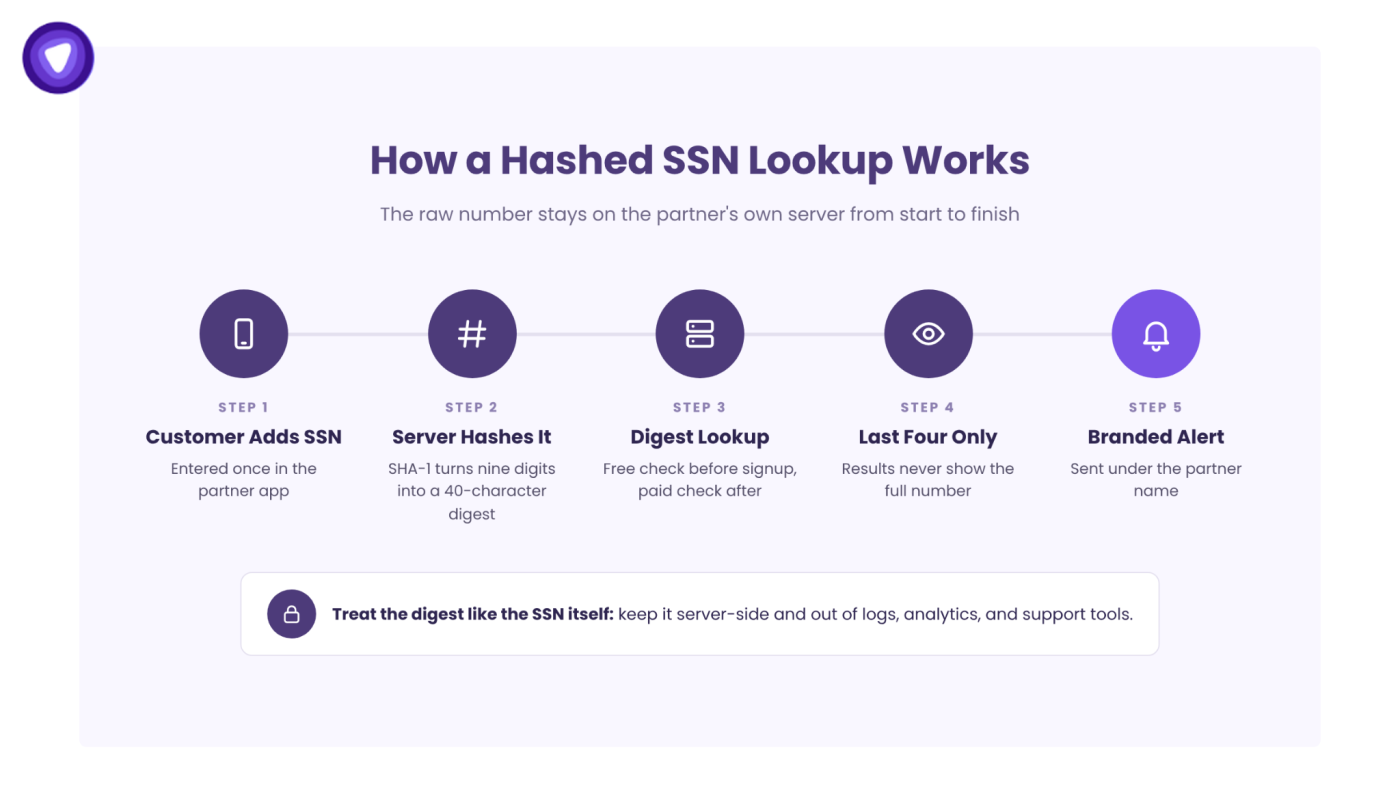
Engineering teams ask the same two questions first. Where does the SSN go, and who can read it? The answers below come from a live API design, so teams can test vendors against concrete behavior.
The Raw Number Never Leaves the Partner Backend
A well-built SSN endpoint never receives the raw number. The partner’s server takes the nine digits, hashes them with SHA-1, and sends only the 40-character digest. The API rejects anything that is not a valid digest. Results include a last-four field, so the interface never needs the full number.
Treat the Hash Like the Number Itself
Hashing keeps the raw SSN out of request logs and vendor systems. However, it does not make the digest safe to share. There are only about one billion possible SSNs, so anyone can hash every one of them quickly. The FTC’s technology team made this point years ago, and it still holds.
In practice, the digest deserves the same care as the SSN itself:
- Create it on the server, never in a browser or mobile app.
- Keep it out of analytics events, crash reports, and support tools.
- Use a keyed hash with a secret key for any internal lookup tables.
- Delete it after the check, unless a scheduled re-check needs it.
Free Checks Before Signup, Paid Checks After
The same lookup can run in two modes. Without a user ID, it runs as a free check, which suits a signup page. With a registered user ID, it becomes a paid lookup tied to that customer’s plan. Disabled or expired users get an error, so lapsed subscribers stop receiving checks on their own. These preview scans turn a moment of curiosity into a conversion path.
Plan the Re-Check Cadence
Daily webhook alerts in this design cover email, phone, and domain assets. SSN checks run as on-demand lookups, so the partner sets the re-check schedule. A practical pattern is a monthly SSN re-check for every active user. Then add an extra check whenever a new email or phone breach fires for the same user. A fresh breach on one identifier is a good reason to re-check the others.
Designing the Alert: What Customers Should Do Next
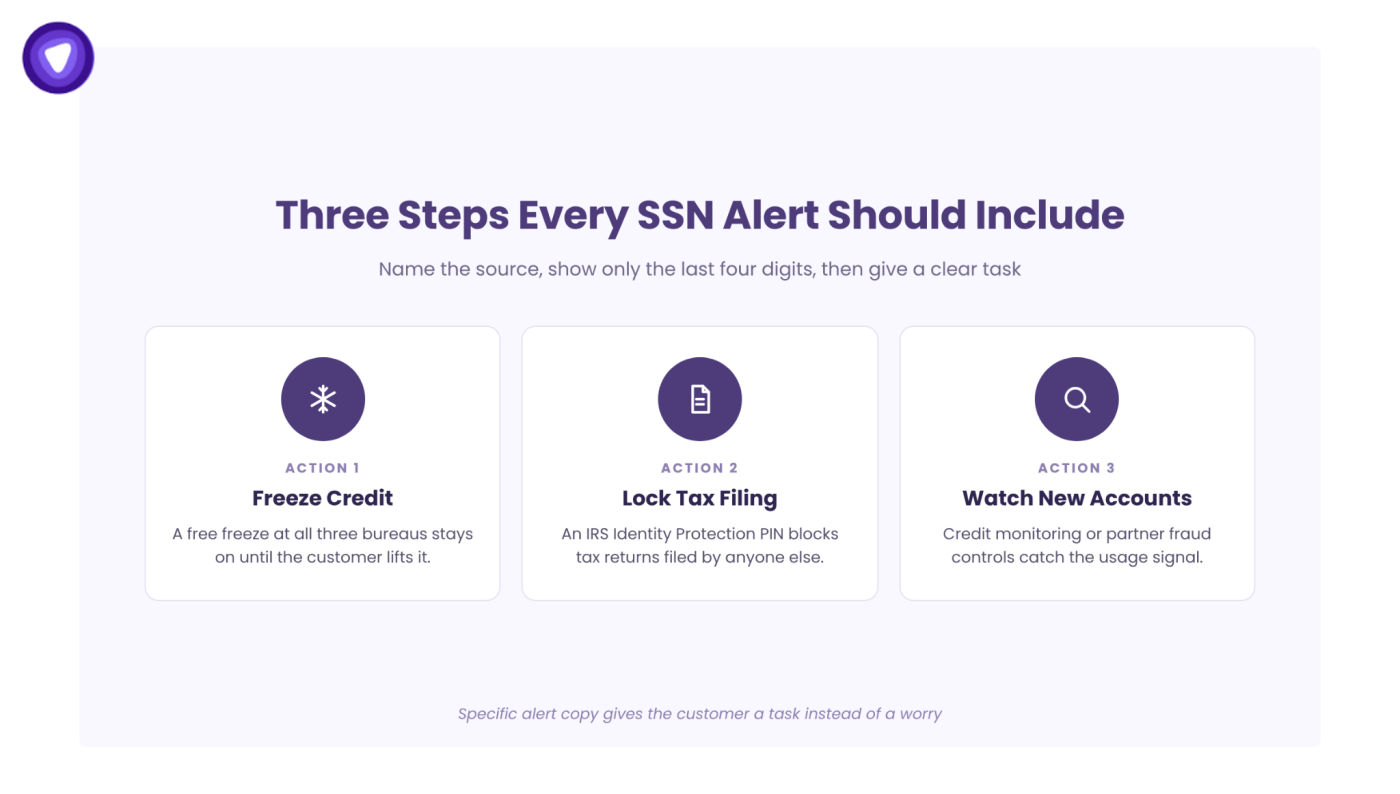
An SSN alert without next steps creates fear and support tickets. A good alert names the source, shows only the last four digits, and gives three clear actions:
- Freeze credit at all three bureaus. A credit freeze is free and lasts until the customer lifts it.
- Lock tax filing. The IRS Identity Protection PIN stops anyone else from filing a return with that SSN.
- Watch for new accounts. Credit monitoring or the partner’s own fraud controls catch the usage signal.
Alert copy should also stay calm and specific. A line that names a 2024 breach record beats a vague warning about identity risk. Specific copy gives the customer a task instead of a worry.
Where SSN Exposure Monitoring Fits by Partner Type
The service fits any partner that already holds customer identity data. Still, three partner types gain the most, each for a different reason.
Fintech Apps
Fintech apps verify identities at signup, so customers expect them to guard those identities later. SSN exposure monitoring extends that care past the login screen. It also gives fraud teams useful context about which customers face higher risk. It does not replace fraud controls. Instead, it adds a layer customers can see and act on.
Insurers
Insurers that sell identity theft coverage carry the cost when exposure turns into fraud. Early alerts give policyholders time to freeze credit before a claim forms. That shifts the product from paying for damage toward preventing it. Monitoring also gives policyholders a reason to open the insurer’s app between renewals.
Security Suites
Security suite customers expect identity protection next to antivirus and password tools. Many consumer identity products already let users add an SSN for monitoring. A suite without that field sends customers to look elsewhere. A white-label service closes that gap without a separate build.
How PureVPN White Label Dark Web Monitoring Supports SSN Exposure Monitoring
PureVPN White Label Dark Web Monitoring runs hashed SSN lookups tied to each registered user. Free preview checks run before signup. Partners launch through a full white-label app, a modular API and SDK, or a hybrid of both. The platform page lists SOC 2 Type II and ISO 27001 certifications, with audit packs shared under NDA. It also reports more than 150 partners, a figure from PureVPN’s own data rather than an independent audit.
The same engine also covers data broker removal across 400+ people-search sites as a separate add-on. Partners who want both can review the removal workflow before they add it to a plan.
Conclusion: Make SSN Exposure Monitoring Part of Your Brand
SSNs now appear in most breach reports, and they never expire. That makes SSN exposure monitoring one of the few identity features with permanent demand. The partner who sends the alert earns the trust, the renewal, and the next cross-sell. The partner who refers customers away earns nothing from that moment.
Start with the decisions that matter most: hashing rules, re-check cadence, and alert copy. Then map the feature to a plan tier your customers already pay for. For the full rollout sequence, the launch guide covers architecture, pricing models, and go-to-market steps.
Request a 20-minute partnership and margin review call.