

Quick answer: Card exposure alerts tell a banking customer when their card or account number appears in breach data. The alert arrives before fraud, inside the app that can lock or replace the card. For fintech and neobank teams, that turns a write-off into a two-tap fix.
Key Takeaways
- Free card data is surging: Recorded Future counted 142 million card records posted for free in 2025, up 26%.
- The bank carries the loss: Regulation E caps most customer liability, so the institution funds most debit and account fraud.
- Customer-facing beats back-office: Card exposure alerts reach the customer and cover cards from any bank, with no BIN ownership needed.
- Hash before lookup: Compute the card hash inside your vault and never store it beside the last four digits.
- One alert, one action: Every match should end in a lock, a replacement, a debit alert, or a scam-call warning.
Every fraudulent card charge your bank absorbs started as an exposure event. A card number leaked from a checkout page, a phishing kit, or an infected laptop. Weeks later, it became a chargeback and a dispute ticket. Then the customer moved their direct deposit elsewhere.
Card exposure alerts close that gap. They check each customer’s card and bank account numbers against breach and dark web records. Then they warn the customer inside your app, where the fix already lives.
This guide covers the economics, the hashing rules your PCI team will raise, and alert design that drives action. It is written for product and risk leads at fintechs, neobanks, and digital banks.
Why Card and Bank Exposure Now Costs the Institution
Stolen card data is now easier to get than to buy. The threat intelligence firm Recorded Future counted more than 142 million card records posted for free in 2025. That was a 26% rise in a single year, according to its payment fraud report.
The same report adds a second warning. Victim email addresses or phone numbers came with 82% of for-sale online card records. That pairing lets a fraudster call a customer, quote their card, and sound like the bank.
Consumer reports show the same direction. FTC data compiled by The Motley Fool shows 503,450 credit card fraud reports through September 2025. That was a 54% jump over the same period a year earlier.
Who Pays When a Card Is Misused
The customer rarely carries the loss. Under Regulation E, a debit cardholder who reports within two business days owes at most $50. Transfers made without the card itself, such as account-number debits, skip that tier entirely.
In practice, the institution funds most fraud on debit cards and bank accounts. Every day a compromised number stays active is a day of open liability on your books. Earlier warnings shrink that window.
Why the Deadline Is Already Here
There is no future deadline to wait for. Nacha’s fraud monitoring rules reached their second phase on June 19, 2026. Every ACH participant, including every receiving bank, now needs risk-based fraud monitoring.
The rules do not name exposure data. Still, a known-exposed account number is a clear risk input. Banks that add it now set controls before the next exam, not after a fraud spike.
What Card Exposure Alerts Cover and What They Do Not
Card exposure alerts watch numbers that already belong to the customer. That scope matters, because card fraud splits into two different crimes. Each one needs a different control.
Existing Card Fraud Versus New Account Fraud
Existing card fraud uses a real card number that leaked. Card exposure alerts target this case directly. The customer learns about the leak, and the bank replaces the card before the fraudster spends on it.
New account fraud is different. A criminal opens a fresh card in the customer’s name, using personal details instead of a card number. That threat needs identity monitoring and data removal. Broker profiles supply the addresses and birth dates that pass recovery checks.
Bank Account Numbers and ACH Debits
A bank account number does not need a card to cause harm. With an account and routing number, a fraudster can push unauthorized debits through the ACH network. The customer often notices only when a statement arrives.
Bank account exposure checks run the same way as card checks. A match tells the customer to watch for unfamiliar debits. It also tells your fraud team to raise scrutiny on incoming debits for that account.
Three Controls Compared
Most banks already run some form of credit card dark web monitoring. The table shows where card exposure alerts fit next to the controls a fraud team usually owns.
| Factor | Issuer BIN Monitoring | Card Exposure Alerts | Transaction Fraud Scoring |
| Who sees the signal | Fraud team only | Customer and fraud team | Fraud team only |
| What triggers it | Card numbers from your BIN range appear for sale | A customer’s registered card or account matches a record | A live payment looks unusual |
| When it fires | Before misuse | Before misuse | During misuse |
| Covers cards from other banks | No | Yes | No |
| Needs BIN ownership | Yes | No | No |
| Customer action | None until the bank reissues | Lock, replace, or call the other issuer | Approve or decline a payment |
Why Neobanks Need a Customer-Facing Layer
Back-office BIN monitoring assumes you control the card range. Many neobanks do not. Card networks issue BINs only to regulated banks, so fintechs launch cards through a sponsor bank instead.
That setup leaves a gap. The sponsor holds the BIN, while the neobank holds the customer relationship. Card exposure alerts work at the customer level, so they fit the party that owns the app.
Customers also carry cards your bank never issued. A budgeting or payments app often stores cards from three or four other banks. A customer-facing check covers all of them, while BIN monitoring covers none.
There is a trust payoff too. A customer who hears about a leak from your app credits your brand. A customer who hears about it from a stranger’s phone call may lose trust in every bank they use.
How Card Exposure Alerts Work Inside a Banking App
The build has three parts: a safe lookup, a clear reading of each match, and a re-check schedule. None of them requires your team to collect new data. Each one reuses numbers you already hold.
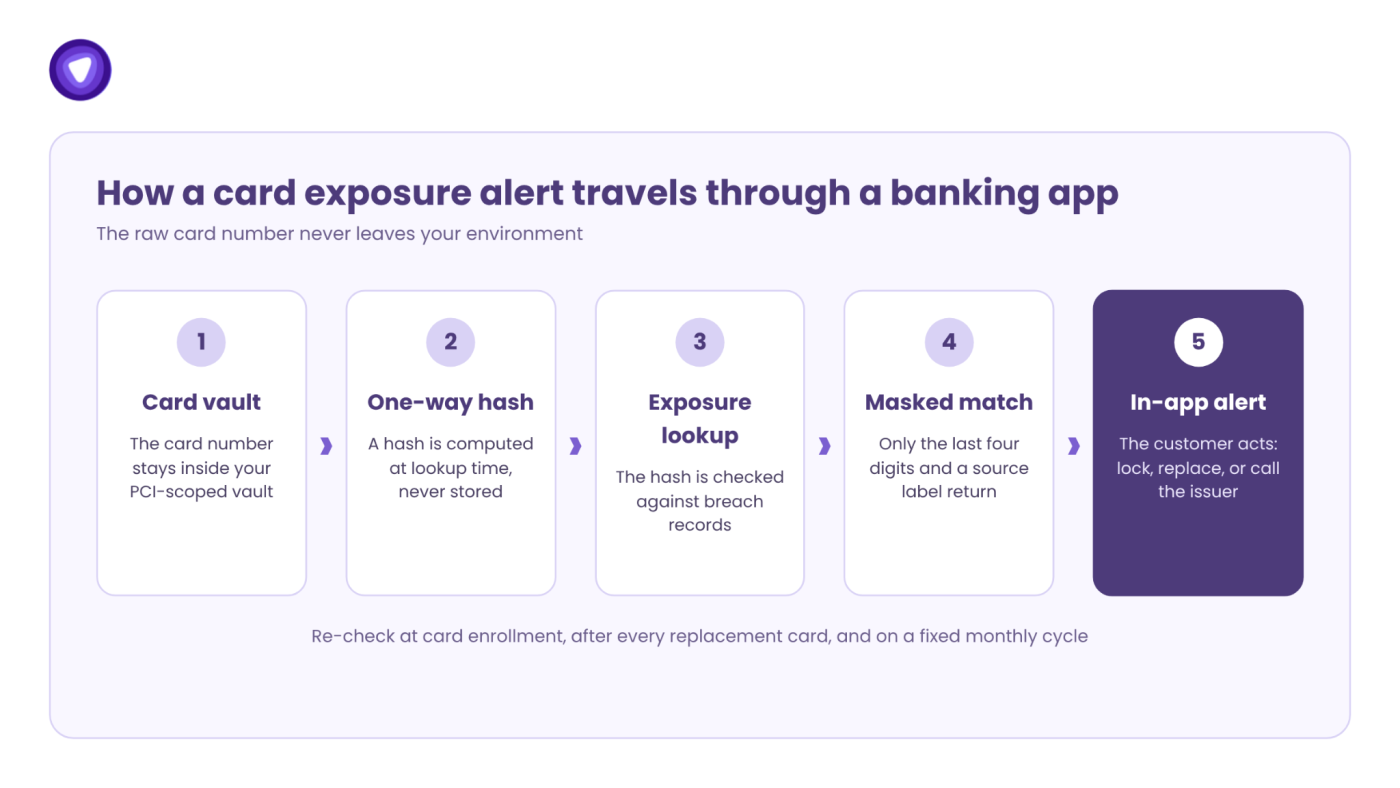
Hash the Card Number Before It Leaves Your Vault
A well-designed exposure API never asks for the raw card number. One production card lookup takes a one-way SHA-1 hash computed on the partner’s side. Any raw card number sent to it is rejected.
Your PCI team will still have questions, and they should. PCI DSS now expects stored card hashes to use a secret key. A plain card hash also carries risk, because card numbers follow known patterns that attackers can test at scale.
Three handling rules keep the lookup inside your existing controls:
- Compute the hash inside your card vault or tokenization layer, at lookup time only.
- Do not store the plain hash next to the last four digits. The PCI Council treats that pairing as a correlation risk.
- Ask your assessor how the lookup step is scoped before launch, not during the audit.
Read the Source Category Before You Act
Not every match means the same thing. Each result carries a source category, such as infostealer, phished, exfiltrated, or combolist. That label tells you how the number leaked and how urgent the fix is.
An infostealer or phished match points to a live device or a recent scam. That calls for an immediate card lock. A combolist match often recycles older data, so a softer prompt can work.
The response also returns only masked card digits and a linked email address. Your app shows the last four digits, so the customer knows which card is affected. Full numbers never travel back.
Schedule the Re-Checks
Card and bank checks run as lookups your backend triggers. That gives your team control over cost and timing. Three moments cover most of the value:
- When a customer adds a card or links an account
- When a replacement card goes live, to confirm the new number is clean
- On a fixed cycle, such as monthly, for every active card
A free preview check can run before signup, which helps conversion. Paid lookups then tie to each registered user, so cost tracks the plan your customers pay for.
Turn Each Card Exposure Alert Into One Action
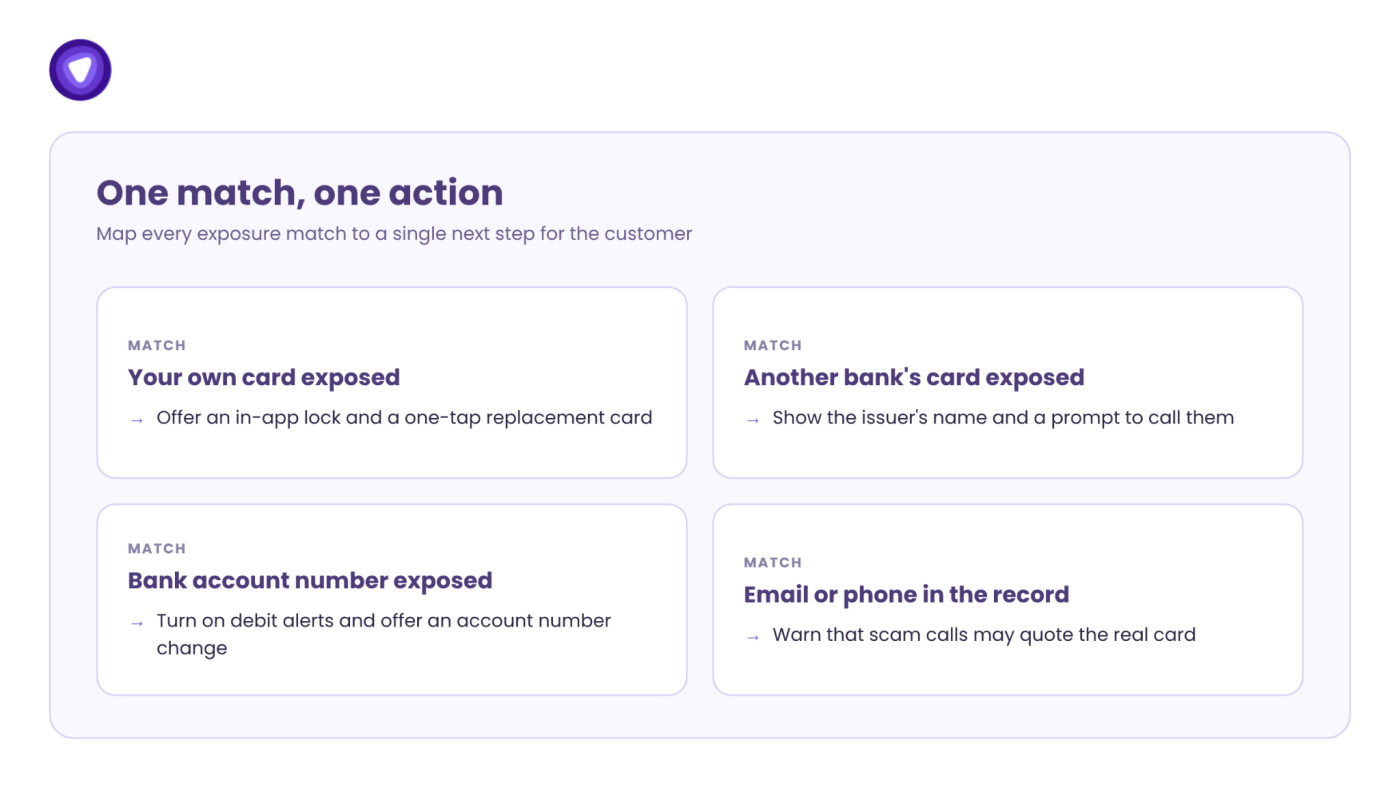
An alert that only worries customers creates support tickets. A breach alert that sends a notice and stops is the gap that exposure intelligence is built to close. Each card exposure alert should end with one clear task.
Map each match type to a single next step:
- Your own card exposed: Offer an in-app lock and a one-tap replacement card.
- A card from another bank exposed: Show the issuer’s name and a prompt to call them.
- Bank account number exposed: Turn on debit alerts and offer an account number change.
- Email or phone in the same record: Warn the customer that scam calls may quote their card.
Write Alerts That Cannot Be Mistaken for Phishing
Remember that 82% of for-sale card records carry contact details. That data lets fraudsters send fake fraud warnings that quote a real card. Your real alert must look nothing like theirs.
Deliver card exposure alerts inside the app, behind the customer’s normal login. A push notification can point there, but it should never carry a link. The alert must never ask for a card number, a PIN, or a one-time code.
State that rule inside the alert itself. A line such as “We will never ask for your card number” trains customers to spot the fake version.
What Early Alerts Change: An Illustrative Example
The figures below are round, illustrative numbers, not benchmarks. Replace them with your own fraud and reissue costs.
Picture a neobank with 200,000 active debit cards. A monthly check flags 0.5% of cards, or 1,000 numbers, with fresh exposure. Suppose 10% of those would have seen fraud before the customer noticed.
That is 100 fraud cases. At an assumed $400 per case in losses and handling, the month costs $40,000. Proactive replacement of all 1,000 cards, at an assumed $8 each, costs $8,000.
The gap pays for the program, and it ignores the retention upside. The customer who got a warning stays. The customer who found the fraud on a statement starts comparing banks.
How PureVPN White Label Digital Privacy Protection Supports Card Exposure Alerts
PureVPN White Label Digital Privacy Protection gives fintechs card and bank account lookups under their own brand. Card numbers arrive only as one-way hashes, and results return masked. Partners launch through a full white-label app, a modular API and SDK, or a hybrid of both.
The platform page lists SOC 2 Type II and ISO 27001 certifications, with audit packs shared under NDA. It also reports more than 150 partners, a figure from PureVPN’s own data rather than an independent audit. The same service adds data broker removal across 400+ sites, which fintech teams can bundle against new account fraud.
Conclusion: Make Card Exposure Alerts Part of Your Banking App
Card exposure alerts move fraud response from the dispute queue to the moment of leak. The bank that warns first replaces a card instead of refunding a loss. It also earns the customer’s trust at the moment it matters most.
Start with three decisions: where the hash is computed, which source categories trigger a lock, and how often you re-check. Then package the feature into a plan tier. Most programs price by monitored asset count, which fits cards and accounts cleanly.
Request a 20-minute partnership and margin review call.