

Quick Answer: Identity exposure intelligence is a discovery layer. It maps what personal data leaked, where it sits, and how it got out. It links breach records, infostealer logs, dark web posts, and data broker listings into one profile per person. That profile then drives monitoring, removal, proof, and repeat checks as one loop.
Key Takeaways
- One profile, not one alert: Identity exposure intelligence links breach, infostealer, dark web, and broker data into a single profile per person.
- Five questions answered: It shows what leaked, where it sits, how it got out, when it surfaced, and which details link.
- Public data counts: Broker listings never trigger a breach alert, yet they answer the recovery questions attackers face.
- Six-stage lifecycle: Discover, understand, monitor, remediate, verify, and re-monitor run as one continuous loop.
- Re-listing is the test: Brokers rebuild removed records, so scheduled rescans and new requests decide whether protection lasts.
A breach alert tells a user one thing. Their email showed up in one leaked database. Then the alert stops. So the user resets a password and treats the problem as closed.
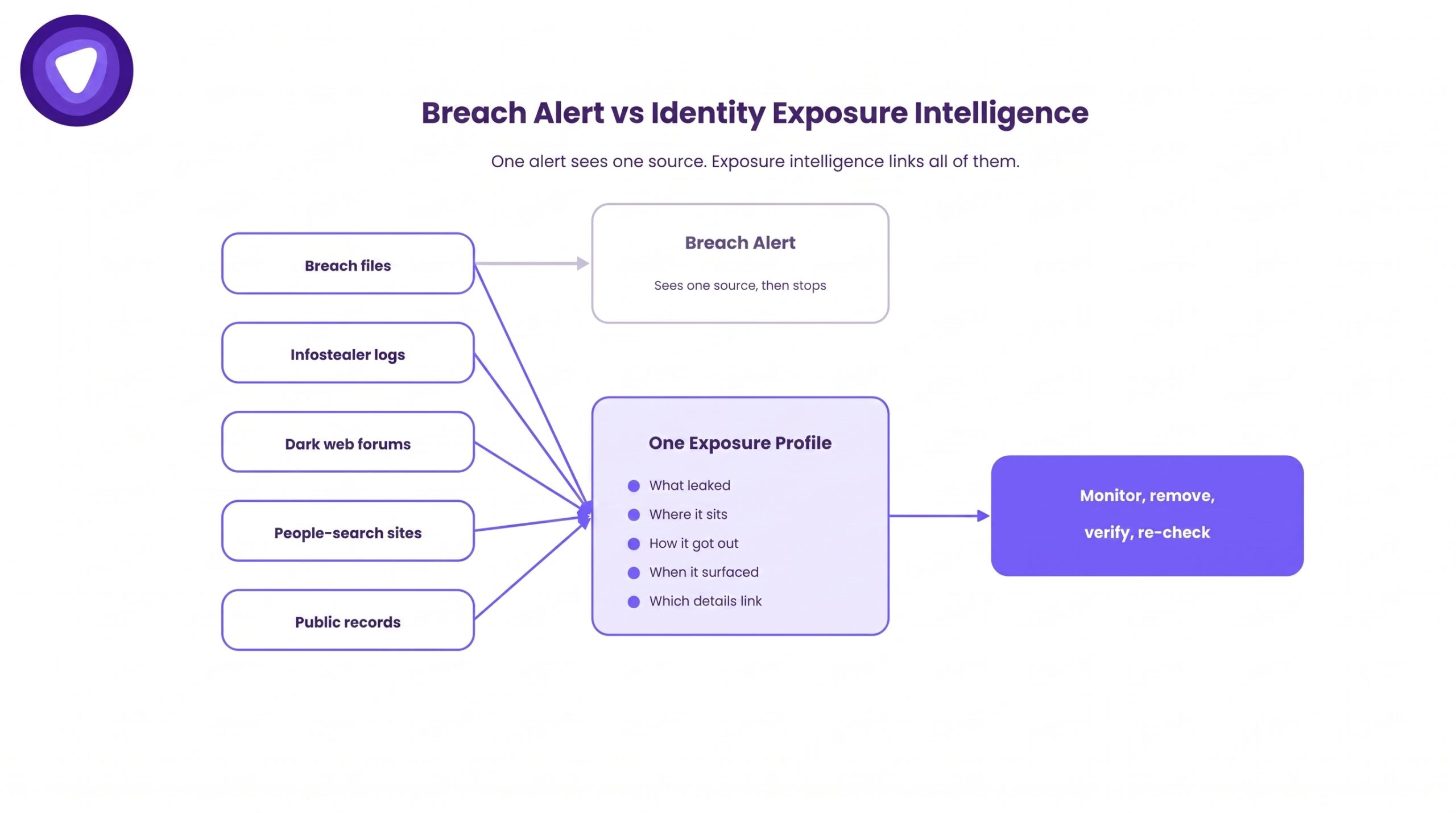
It rarely is. For example, the same email often sits in an infostealer log and a combo list. It may also sit on a people-search page beside a home address. A single alert sees one of those. By contrast, identity exposure intelligence sees all of them and links them.
That gap carries a real cost. In 2024, the FTC took in more than 1.1 million identity theft reports through IdentityTheft.gov alone. Each one began with exposed data that someone used first. For security and fintech platforms, each case can turn into a support ticket, a refund, or a lost plan.
This guide explains what identity exposure intelligence is and how it differs from a breach alert. Then it walks through the six stages of the full exposure lifecycle.
What Identity Exposure Intelligence Means
Most definitions online treat the term as a password feed for security teams. That view is too narrow. After all, exposure does not stop at passwords, and it does not stop at the dark web.
The Definition
Identity exposure intelligence gathers personal data exposure from many sources and links it together. The result is one profile per person, not a pile of separate incidents. In short, it is the first layer of a wider digital privacy protection service.
It pulls from five kinds of sources:
- Old breach files and leaked password sets
- Infostealer logs and combo lists
- Dark web forums and markets
- People-search sites and data broker listings
- Public records and sites that pool identity data
The Five Questions It Answers
A breach alert answers one question: did this email show up in a breach. In contrast, identity exposure intelligence answers five:
- What data is out, such as an email, a phone number, or a home address.
- Where it sits, from a forum post to a people-search page.
- How it got out, through a breach, malware, or a broker.
- When it showed up, and whether it is old, repeated, or new.
- Which details link together across separate data sets.
That last question matters most. An email in one breach and a phone number in another look harmless apart. Once linked, though, they give an attacker enough to pass an account recovery call.
Why Breach Alerts Fall Short
Breach alerts were the first wave of consumer identity protection. They still have value. However, three gaps limit how much they protect on their own.
Alerts Miss the Fastest Leak Source
Breach databases update only after a company reports an incident. Infostealer malware moves much faster. It lifts saved passwords and session cookies straight off an infected device.
The Verizon 2025 Data Breach Investigations Report shows how tight that link runs. Among ransomware victims, 54% had prior credential exposure in infostealer logs. The same report found company logins on 46% of unmanaged devices in those logs. So one infected home laptop can leak work and bank logins at once.
Alerts Ignore Public Exposure
Also, not every exposure is stolen. Data brokers collect names, addresses, phone numbers, and relatives from public filings and paid data feeds. Then they post that profile on people-search sites. No breach alert will flag it, because nothing was hacked.
For fintech platforms, this public data is the risky half. It answers the identity questions inside password resets and support calls. As a result, attackers use it to pass recovery checks with a leaked password in hand.
Alerts End Where Action Should Start
A breach alert sends a notice and closes the case. It does not remove anything, confirm anything, or watch for a repeat. Instead, the user must find, fix, and track every other exposure alone.
Breach Alerts vs Dark Web Monitoring vs Identity Exposure Intelligence
People often use these three terms as if they mean the same thing. They do not. Each one covers a different share of the problem, and the table below sets them side by side.
| Factor | Breach Alert | Dark Web Monitoring | Identity Exposure Intelligence |
| Core question | Was this email in a known breach | Has new exposure appeared today | What is exposed, where, how, and how is it linked |
| Time focus | Past incident | New exposure going forward | Old, repeated, and new exposure together |
| Sources | Reported breach databases | Forums, markets, infostealer logs, combo lists | Breach data, infostealer logs, dark web sources, broker listings, public records |
| Output | One notice per incident | A stream of alerts | One linked exposure profile per person |
| Public broker data | Not covered | Not covered | Covered |
| Leads to removal | No | No | Yes, through data broker opt-out |
| Ends when | The notice goes out | The plan ends | Never, it feeds an ongoing lifecycle |
Dark web monitoring and identity exposure intelligence work as a pair. First, exposure intelligence builds a baseline of what already leaked. Then monitoring watches for anything new. Our guide to the alert pipeline shows how that second layer finds and sends each alert.
The Full Exposure Lifecycle in Six Stages
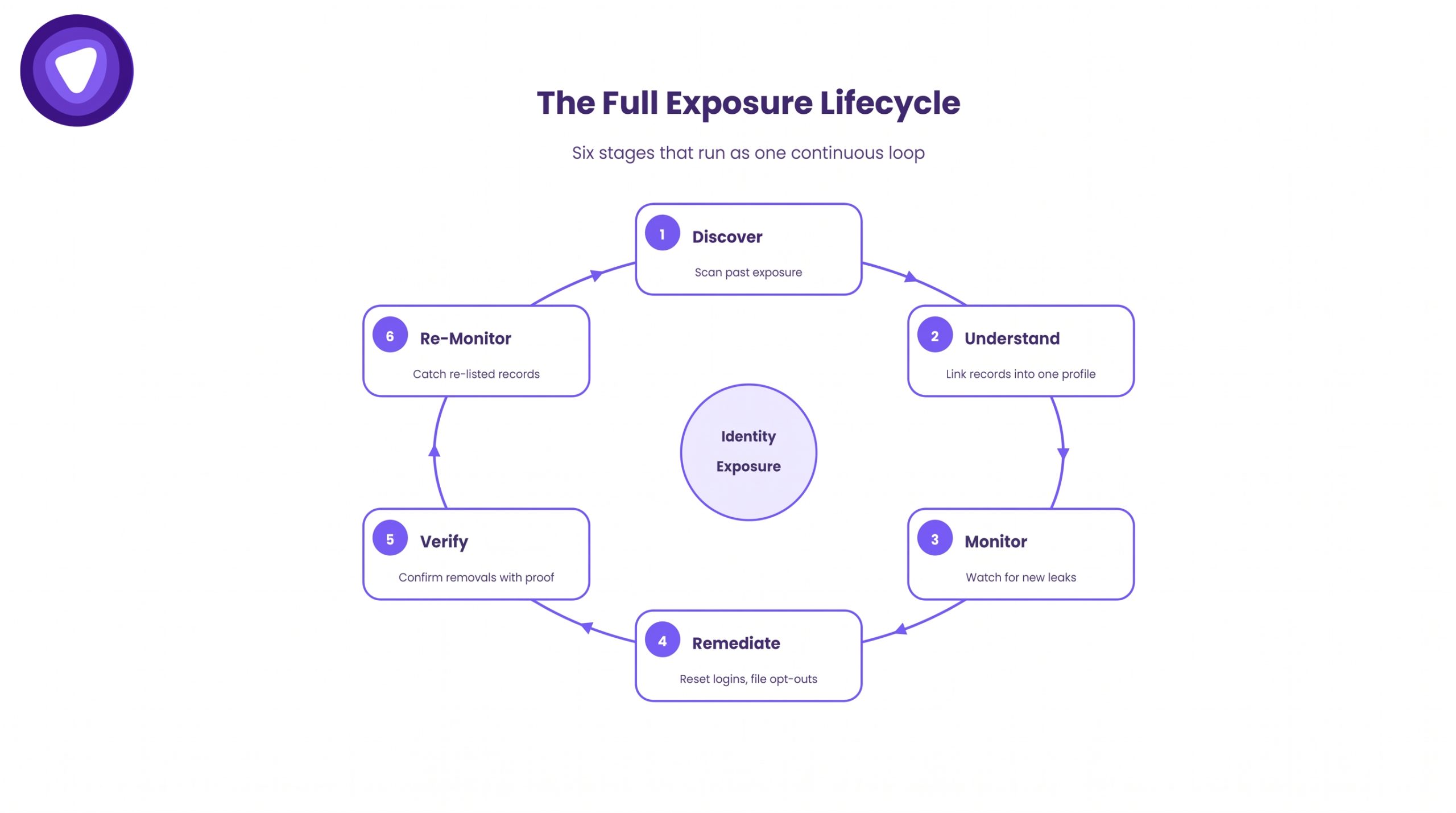
Identity exposure intelligence is the first stage, not the whole product. A complete service carries each exposure through six stages. Each stage hands its output to the next, and the last stage loops back to the first.
Stage 1: Discover
First, discovery runs a scan of past exposure across every supported source. It starts with what the user enters, such as an email, a phone number, or a username. Within seconds, the scan returns a total exposure count. That count gives the user a baseline before they choose what to protect.
Stage 2: Understand
Next, the platform links the raw results into one profile. This stage splits real exposure from noise. It also ties together details that sit in different data sets.
Accuracy decides whether this stage helps or harms. A 2025 study at the Privacy Enhancing Technologies Symposium tested paid removal services with 71 people. Only 41.1% of the records those services flagged were actually about the person. A profile built on the wrong records sends users chasing data that is not theirs. In other words, match quality is what turns raw data into intelligence.
Stage 3: Monitor
Once the baseline exists, each identifier goes under a constant watch. The watched sources include breach feeds, infostealer logs, combo lists, forums, and markets. A new match fires an alert inside the partner product, with its source and date attached. As a result, the user moves from a one-time check to a standing watch.
Stage 4: Remediate
This is where exposure intelligence turns into action. For stolen logins, the fix is a password reset, a session sign-out, or a card freeze. For public listings, the fix is data broker opt-out.
The opt-out workflow runs in a fixed order:
- The user gives consent for the service to act for them.
- The platform finds each listing, the data it shows, and the proof.
- Next, it files a removal request through each broker’s own process.
- Finally, each request moves through tracked states, from submitted to completed.
Still, removal has a legal limit. It cuts the personal data that supported broker sites show to the public. However, it does not delete government records, court filings, or public registries that the law keeps open.
Stage 5: Verify
A filed request is not a removed record. So verification checks whether each listing came down, got hidden, or stays visible. Proof such as listing details and screenshots shows the user what changed. Without this stage, a user has no proof the service did anything at all.
Stage 6: Re-Monitor
Brokers rebuild their records from fresh public filings and resold data feeds. So a removed listing can return months later. Re-monitoring rescans supported sources on a schedule and catches each return. When data shows up again, the platform files a new request on its own.
Regulators now treat this cycle as a duty, not a favor. California brokers that miss deletion cycles face per-day penalties for each open request. That pressure makes re-listing the stage users notice most. It is also the stage weak services skip.
What the Lifecycle Changes: An Illustrative Example
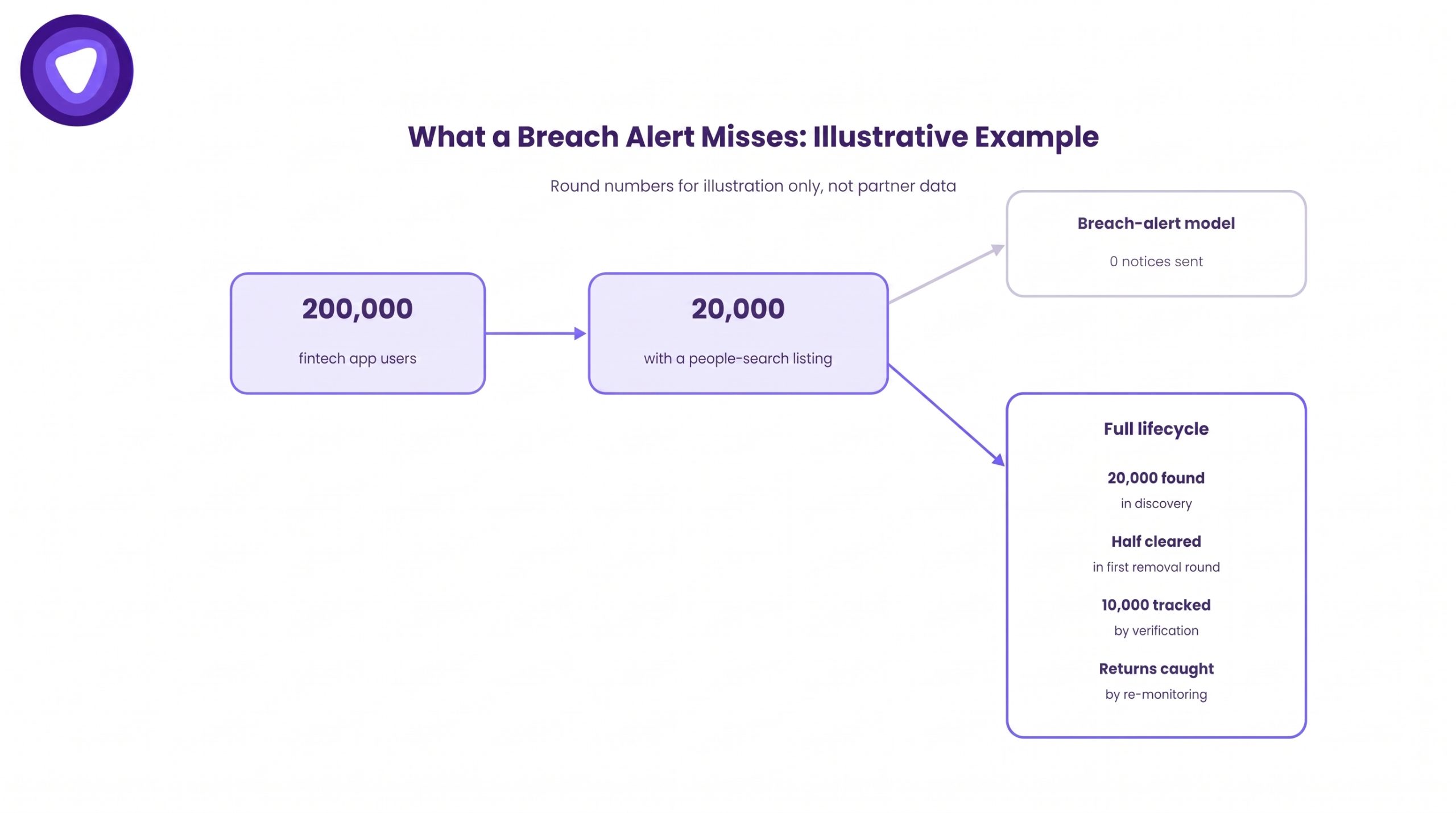
Round numbers make the gap between the two models easy to see. The figures below are illustrative, not data from any partner.
Take a fintech app with 200,000 users. Assume 10% have at least one people-search listing that shows a home address. That gives 20,000 exposed users.
Under a breach-alert model, none of those 20,000 get a notice. After all, their listings were never part of a breach. So every one of them stays open to a fake caller at the support desk.
Under the full lifecycle, all 20,000 show up during discovery. Now suppose the first removal round clears half of them. Verification shows exactly which 10,000 remain. Meanwhile, re-monitoring catches any listing that comes back. As a result, the platform knows its exposure at every point instead of guessing.
Who Uses Identity Exposure Intelligence
Identity exposure intelligence began as a tool for large company security teams. Today, the same tool reaches consumers through apps they already use. Security and fintech platforms sit at the center of that shift, though for different reasons.
Security Suites
An antivirus app protects the device. Exposure intelligence extends that cover to the user’s data beyond the device. It covers leaked logins, broker listings, and exposed details the suite never held. Adding it to a security suite also raises a build, bundle, or refer choice that shapes revenue for years.
Fintech Platforms
Fintech apps, on the other hand, hold accounts that move money. For that reason, their risk sits less at the login page and more at the recovery desk. Exposure intelligence tells a fraud team which customers an attacker can look up today. A re-listed record then becomes a signal to add checks on high-risk requests.
How Partners Package It
Most platforms do not sell exposure intelligence as its own product. Instead, they put the discovery scan in the base plan to build trust. Then monitoring and removal sit in paid tiers. Each stage has its own cost curve, which our pricing model guide breaks down.
How PureVPN White Label Digital Privacy Protection Delivers the Lifecycle
PureVPN White Label Digital Privacy Protection runs dark web monitoring and data broker opt-out on one engine. Identity exposure intelligence feeds both. A scan of past exposure returns a total count in seconds across breaches, infostealer logs, and 400+ people-search sites. The platform files opt-outs wherever a site allows, tracks each one to its status, and checks again monthly. It also captures proof at every step, including listing details and screenshots.
Partners can launch it as a full branded platform, a modular API and SDK, or a mix of both. In addition, the platform holds SOC 2 Type II and ISO 27001 certification. The 400+ site and 150+ partner figures are PureVPN’s own reported data, not third-party audited. See the full product overview for launch options.
Conclusion: Identity Exposure Intelligence Starts the Loop
A breach alert answers one question and stops. By contrast, identity exposure intelligence answers five and hands the answers to a lifecycle that keeps going. Discover, understand, monitor, remediate, verify, and re-monitor work as one loop. Platforms that ship only the first alert leave users exposed on every source that alert never saw.
For security and fintech platforms, the next step is to map which stages your product already covers. The gaps show where exposure still reaches your users.
Request API sandbox access for a 20-minute integration walkthrough.
Frequently Asked Questions
What is identity exposure intelligence?
It is the discovery layer that links breach, infostealer, dark web, and broker data into one profile per person.
How is identity exposure intelligence different from dark web monitoring?
Exposure intelligence maps past exposure across all sources, while dark web monitoring watches for new leaks going forward.
How is identity exposure intelligence different from a breach alert?
A breach alert flags one incident, while exposure intelligence links every exposure and feeds removal and re-checks.
What data does identity exposure intelligence check?
It checks emails, phone numbers, usernames, addresses, IP addresses, leaked logins, and card or ID references.
Can identity exposure intelligence remove exposed data?
No. It finds the exposure, and the data broker opt-out stage then files each removal request.
Why does removed data come back on broker sites?
Brokers rebuild records from fresh public filings and resold feeds, so removal needs scheduled rescans and new requests.
How accurate are identity exposure matches?
Match quality is the weak point, since one 2025 study found only 41.1% of flagged records matched the person.