
Browse all categories

Malicious AI Coding Skills Are Slipping Past Security Scanners at a 90 Percent Rate, Here Is How

Author Haris Shahid

What is Silk Road on the Dark Web

Published: July 7, 2026
Last Updated: July 7, 2026
Severity
High
Threat Type
AI Coding Agent Supply Chain Attack, Scanner Evasion Technique
Affected Platform
Claude Code, OpenAI Codex, OpenClaw, and any AI agent that installs third-party skills.
Records Exposed
Not a single breach event. This is a disguise technique that allows already-malicious skills to bypass traditional security scanners.
Data Types at Risk
Saved credentials, API keys, source code, browser sessions, SSH keys, cloud secrets, and customer data processed by the AI agent.
Status
Active Confirmed by academic researchers, with related evasion techniques already observed on public AI skill marketplaces.
Identity Risk Level
Elevated

Researchers at the Hong Kong University of Science and Technology built a tool called SKILLCLOAK that rewrites malicious AI agent skills so they look clean to scanners while behaving exactly the same underneath.

Tested against eight scanners and 1,613 real malicious skills pulled from the ClawHub marketplace, the tool’s strongest technique bypassed every scanner more than 90 percent of the time, and most scanners more than 99 percent of the time, according to the researchers’ paper, Cloak and Detonate.
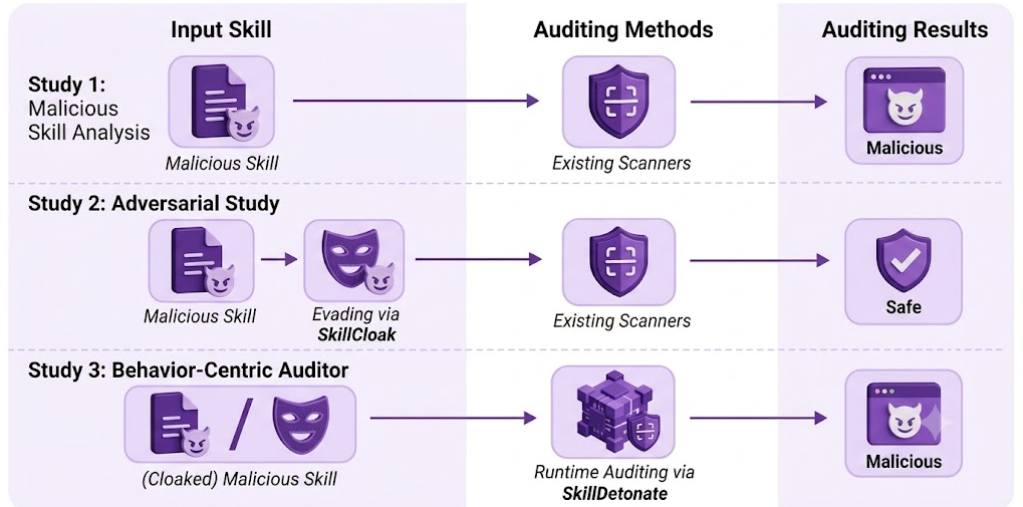
A lighter disguise technique still cleared more than 80 percent of scanners and reached 96 percent against one hybrid scanner. On production agents including Claude Code and OpenAI Codex, the disguised skills performed identically to the original malicious versions, meaning the attacker loses nothing by hiding the payload.

Skills Are Small Installable Packages That Run With the Same Access as the Agent Itself

A skill is typically a Markdown instruction file paired with a few scripts that an AI coding agent loads to gain a new capability. Because a skill is just a bundle of files, the same one can run across different agents including Claude Code, OpenAI Codex, and OpenClaw, as reported by The Hacker News.

Once installed, a skill runs with the agent’s own permissions. That means access to the user’s files, terminal, and saved passwords. A malicious skill can steal credentials, copy source code, or install a backdoor, and most public skill marketplaces accept uploads from strangers with little to no vetting.

The Disguise Works Two Ways, and One of Them Hides the Payload Where Scanners Never Look

The lighter technique, called Structural Obfuscation, rewrites the exact bytes a scanner keys on. It swaps a character for a lookalike from another alphabet, or splits a flagged command across a newline, so the scanner’s pattern match fails while the command still runs unchanged.

The heavier technique, Self-Extracting Skill Packing, moves the entire malicious payload into a directory scanners typically skip, such as .git, hidden behind a harmless-looking decoder. The decoder only rebuilds the payload once the agent actually runs the skill, which is precisely the moment static scanning has already finished.

A Behavior-Based Checker Catches What Scanners Cannot See Before a Skill Runs

Since appearance can be faked, the same research team built SKILLDETONATE, a runtime auditor that executes a skill inside a sandbox and watches what it actually does at the operating system level: what it reads, what it writes, and where it sends data.

In a controlled benchmark, SKILLDETONATE caught 97 percent of attacks while incorrectly flagging only 2 percent of safe skills. Against real-world malicious skills pulled from the wild, it caught 87 percent, a rate the researchers report held steady even when the skills were cloaked. The tradeoff is speed, taking a couple of minutes per skill against a scanner’s few seconds, though it only needs to run once before a skill goes live.

One of the Industry’s Strongest Scanners Dropped From 99 Percent Detection to Roughly 10 Percent

Cisco’s scanner, the strongest of the eight tested in the paper, caught 99 percent of real-world malicious skills before they were cloaked. After SKILLCLOAK’s disguise was applied, that detection rate fell to approximately 10 percent, illustrating that even the best-performing static scanner in the study could not hold up against payload-preserving evasion.

Malicious Skills Already Live on Public Marketplaces Are Using These Exact Tricks Today

Bitdefender found that roughly 17 percent of the skills it examined on one AI agent marketplace carried hidden malicious code, according to Dark Reading. Separately, Koi Security’s audit of the ClawHub marketplace found 341 malicious skills in a single campaign it named ClawHavoc, a number that grew to 824 as the marketplace expanded past 10,700 listings, based on Koi Security’s published research.

Palo Alto Networks’ Unit 42 identified five evasive skills still live on ClawHub despite the marketplace’s built-in scanning. One, named omnicogg, padded its README file with 22 megabytes of junk data specifically to slip past the scanner’s size cap, matching the exact size-padding technique the SkillCloak paper tests. Two of the five delivered Mac password-stealing malware, and two others hijacked the agent’s financial advice output to push affiliate links and manipulate meme-coin launches for profit.

The Same Blind Spot Is Showing Up Outside Skill Marketplaces Entirely

Researchers at Mozilla’s 0DIN team demonstrated that a completely clean GitHub repository, containing no malicious code at all, could still trick Claude Code into opening a reverse shell on a developer’s own machine. The repository shipped a package designed to fail on first run with an error message instructing the user to run an initialization command, which then fetched a malicious payload from a DNS text record controlled entirely by the attacker, as detailed in coverage from DevOps.com.

Because the payload never existed in the repository itself, no static scan or human code review had anything to catch. The malicious instruction only materialized once the agent actually executed the setup script, the same runtime blind spot the SkillCloak research exploits inside skill marketplaces.

Don’t Let Cybercriminals Turn You Into a Bestseller.

Enter your email below to scan for any breaches or leaks on the dark web instantly.

A Separate Microsoft Warning Shows the Same Trust Assumption Breaking in Finance Workflows

Microsoft warned that a legitimate, already-approved AI agent tool can be silently poisoned after the fact. In its documented example, an attacker modified a third-party invoice enrichment tool’s description after it had already passed security review, quietly instructing the connected finance agent to collect and leak unpaid invoice data, according to the Microsoft Security Blog.

The technical mechanism differs from SkillCloak, but the underlying assumption that breaks is identical. Passing a one-time review, whether a static scanner or a security sign-off, does not guarantee that what runs later is what was actually reviewed.

What This Means for Any Business Running AI Coding Agents or Chatbot Assistants?

Any organization letting employees install third-party skills, plugins, or MCP tools for AI agents is exposed to this class of attack, regardless of which agent brand is in use. The risk applies directly to developers using Claude Code or Codex, to teams running OpenClaw-based automation, and to any business connecting AI agents to email, finance, or customer data systems.

The practical consequence is credential theft, source code exfiltration, and backdoor installation on developer machines, which frequently hold the highest-value secrets in a company: API keys, cloud credentials, and access tokens for production systems.

The Identity & Credential Theft Risk This Creates for Developers and Businesses

A compromised developer machine typically exposes API keys, cloud provider credentials, Git tokens, SSH keys, and any saved passwords stored in the environment, all of which can be used for direct account takeover across connected business systems.

Stolen source code and internal documentation can be used to craft highly convincing follow-up phishing or business email compromise attempts against colleagues, since the attacker now has real internal context to work with. Cryptocurrency wallets and financial credentials are a documented target, since several malicious skills found in the wild were built specifically to steal or manipulate financial accounts.

Immediate Action Steps for Developers and Security Teams

First 24 Hours

Audit every third-party skill, plugin, and MCP tool currently installed across Claude Code, Codex, OpenClaw, or any other agent in use. Remove anything from an unverified source or an account with no established reputation.

Rotate any API keys, cloud credentials, or tokens that were accessible to an agent that had a third-party skill installed, regardless of whether compromise has been confirmed.

First Week

Review agent execution logs for unexpected network connections, file reads outside the expected project scope, or commands that were not explicitly requested by the developer.

Restrict network egress for agent sandboxes during setup and initialization steps specifically, since this is the exact window the DNS-based and runtime-packed payloads described above are designed to exploit.

Ongoing Practices

Treat every third-party skill and MCP tool as untrusted code regardless of how professional its documentation looks, and require human approval before any automated setup command runs.

Adopt runtime behavioral monitoring rather than relying on scan-at-install as the only control, since this research demonstrates static scanning alone is not sufficient for this attack class.

How PureVPN Identity Protection Helps

PureVPN Identity Protection runs continuous dark web monitoring that flags stolen credentials, API keys, and account details the moment they surface in a leak, including data harvested through AI agent supply chain attacks like this one. Real time breach alerts and credential exposure tracking give developers and businesses an early warning window to rotate keys and lock down accounts before stolen access is used for further damage.

div class=”dark-web-scanner-wrapper”>

Don’t Let Cybercriminals Turn You Into a Bestseller.

Enter your email below to scan for any breaches or leaks on the dark web instantly.

Indicators Security Teams Can Watch For

IndicatorDescriptionWhy It Matters
Oversized documentation filesREADME or instruction files padded well past a normal sizeMatches the exact size-cap evasion used by the omnicogg skill
Hidden directories in a skill packagePayload code stored inside .git or similar folders scanners typically skipThis is the core mechanism behind SKILLCLOAK’s Self-Extracting Skill Packing
Setup scripts that fetch code at runtimeInitialization commands that pull additional instructions from an external source, including DNS recordsMatches both the SkillCloak packing technique and the Mozilla 0DIN reverse shell demonstration
Unicode lookalike characters in scriptsCharacters swapped for visually identical characters from another alphabetMatches SkillCloak’s Structural Obfuscation technique
Tool descriptions that change after approvalAn already-approved MCP tool or skill whose description is modified post-reviewMatches the Microsoft-documented tool poisoning pattern

Broader Context

This research lands inside a wider pattern of attackers treating AI agent infrastructure itself as the attack surface, rather than targeting the underlying model. Public skill marketplaces, MCP tool descriptions, and even clean-looking GitHub repositories have all been shown to carry the same structural weakness: a one-time review at install time cannot account for behavior that only appears at runtime.

The paper’s authors are direct about the limits of their own findings. No confirmed real-world campaign has yet been tied to the exact SKILLCLOAK techniques described, the runtime checker remains a research prototype untested on a live marketplace, and the performance figures come from a single group’s preprint that has not yet been peer-reviewed.